Beneficial owners
Verifying the business is not enough on its own. Rootline also has to know the natural people who own and control it, the beneficial owners, and verify their identity.
Who counts as a beneficial owner
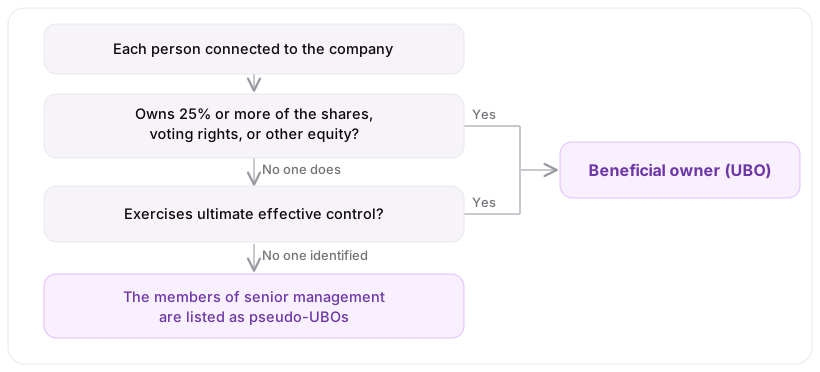
A beneficial owner (UBO) is a natural person behind the company. Rootline identifies them in one of two ways:
- Through ownership: any individual who directly or indirectly owns 25% or more of the shares, voting rights, or other equity in the company.
- Through control: if no one owns 25% or more, any individual who exercises ultimate effective control over the company.
If neither test identifies anyone, the members of senior management are listed instead, as pseudo-UBOs, so there is always a real person accountable behind every merchant.
Roles
Each person related to a company holds one or more roles, and, where relevant, an ownership stake:
| Role | Meaning |
|---|---|
| UBO | A beneficial owner, as defined above. |
| Owner | An owner of the company. |
| Shareholder | Holds a share in the company. |
| Director | Appointed to direct the company. |
| CEO / CFO | Chief executive or financial officer. |
| Representative | Authorized to act for the company. |
| Other | Any other relationship, described in free text. |
The same person can hold several roles at one company, for example both director and shareholder, and an ownership percentage (0 to 100) is recorded against the person where they hold a stake.
What each person provides
For each person, Rootline collects their first and last name, date of birth, email, phone number, country of birth, and one or more identity documents. An identity document is one of: Passport, National ID card, or Residence permit.
Rootline screens the people behind the company as part of its assessment, and uses the business registers to help identify who the beneficial owners are.